
There was a time when computers were optional for many businesses. They were expensive, limited, and often used only for basic tasks like finance and spreadsheets. That time is long gone.
Today, nearly every business depends on IT in some way. Technology supports finance, marketing, production, design, customer service, and almost every other part of day-to-day operations.
Because technology is now so common, simply “using IT” is no longer enough to stand out. It is the baseline. The real advantage comes from using technology strategically.
Quite the contrary. However, to gain that advantage IT can no longer be considered an operational issue but must be given a seat at the board table and aligned strongly with the overall business strategy. So, essentially, there’s no competitive advantage in merely ‘using’ technology these days, but in using it strategically in alignment with the overall business goals. While IT and business are now deeply connected, many organizations still treat them as separate worlds. IT teams may not always have full visibility into business priorities, while business teams may only think of IT when something breaks or a system needs support. Of course, there is a divide between people who work in IT and those who work in traditionally defined business units. This divide was initially intentional, but as technology slowly then suddenly became a requirement for global and local businesses, this divide is now seen as a hindrance. Today, companies recognize the need to align IT and business. A Gartner report recently noted that by 2022, half of organizations were already prioritizing increased IT-business collaboration – a trend that has only accelerated since. The problem, though, is that IT-business alignment isn’t easy to achieve.

Business and IT: problems with the current state
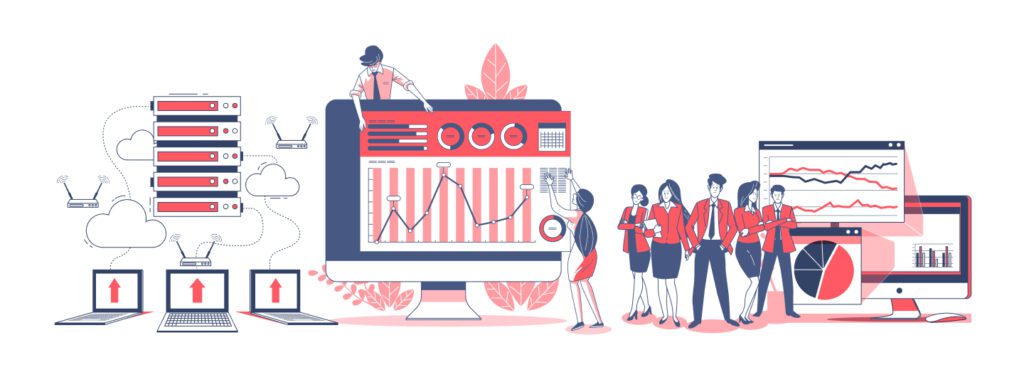
Most companies can agree that business and IT aren’t working as closely as possible to optimize their service and product delivery. The often-cited reason? Traditional business units function very differently from technology. Other reasons: Stereotypes perpetuate misconceptions about how business sees IT and vice versa. Non-IT personnel think IT is too technical to understand, and they might fail to recognize that IT participates in core revenue-generating activities like sales, marketing, customer service, etc.
Though these stereotypes are changing in the 21st century, different disciplines do have inherently different cultures, objectives, incentives, languages, and skillsets. It’s how writing makes sense to some people, and others are more comfortable working with numbers and spreadsheets. Despite the elevation of roles like CTOs and CIOs, tech leadership continues to report significant struggles when attempting to collaborate with business units. You might easily recognize a problematic IT-business relationship. Indicators that these differences are hurting your company often show up in problems like:
- Underperforming systems, projects, or teams
- Technology investments with poor ROI
- Bottlenecks that slow service delivery or deployments
- Friction between business processes and technical solutions
- Inconsistent customer service experiences
- Poor communication or support for employees, end users, or customers

Every organization today must become a technology business, no matter what product or service you offer. This shift is inevitable, and with it comes the concept of IT-business alignment: that IT enables business and business drives IT efforts. Neither is less necessary; both are revenue-generating.
So how do you achieve business and IT alignment?

Think about quantifying what business and IT bring the company—when they work alone and when they work together. The lynchpin is the understanding that when IT and business work in tandem, as partners, both will achieve more. The most successful organization creates a unified team, using the best of all available skills and resources so that each employee gets to work smarter. And every customer gets a better experience.
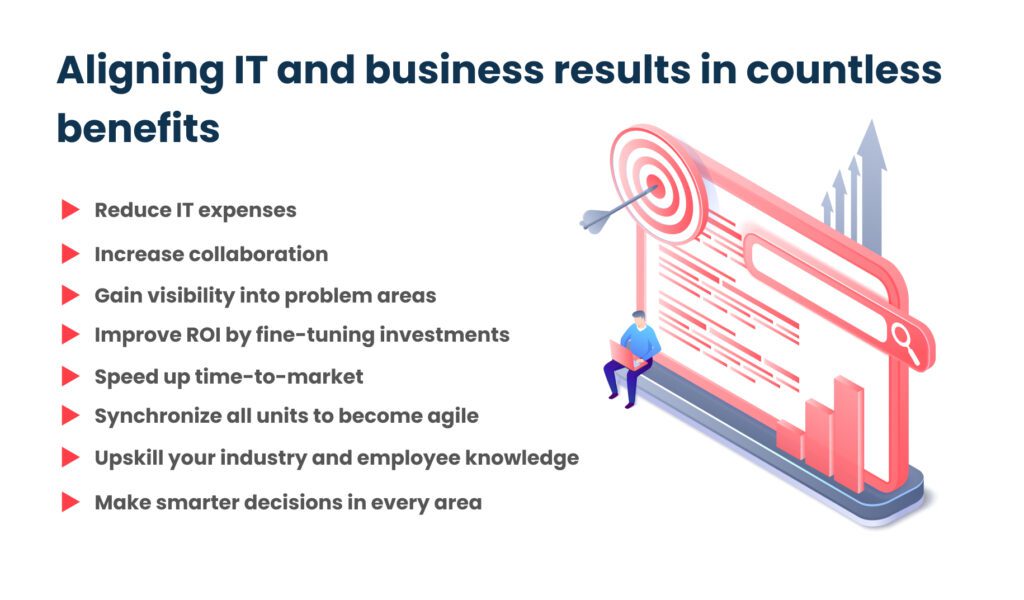
How to Create and Improve IT and Business Alignment
1. Realize the power of analytics
Data can offer meaningful insight into the effectiveness of current strategies and the viability of proposed solutions. By using analytics in your business processes, you can better analyze different aspects of your operations and find worthy opportunities for increased alignment. Developing analytics-based initiatives allows companies to use data effectively and gain valuable insight. To do this, create quantifiable goals you can measure.
2. Identify and eliminate “Shadow IT” overlap
Alignment often fails when departments buy their own tech without consulting IT – a phenomenon known as Shadow IT. Perform a thorough audit to check for redundancies in your operations. You may find you are paying for three different project management tools across marketing, sales, and operations, or that two departments are manually entering the same data into different systems. Consolidating these overlaps reduces costs and ensures your data remains a “single source of truth” across the entire company.
3. Establish a shared communication cadence
Real communication is about creating a structured rhythm between departments, not just “talking more.” To align effectively, move beyond the “emergency-only” interaction. Develop consistent channels – such as cross-departmental steering committees or shared digital workspaces – that allow IT to hear about business goals before they become urgent requirements. When leadership meets frequently with tech teams, adjusted priorities are communicated in real-time, ensuring IT resources are always focused on the projects with the highest business impact.
4. Ensure understanding of company goals
Businesses are most successful when everyone at the company understands the values and goals of the organization. If you plan to improve your business alignment by updating your leadership structure, reporting techniques or communication channels, ensure everyone understands what you plan to do and what the goals are. This can reduce confusion and improve employees’ willingness to support long-term goals.
5. Build stronger relationships
To create a greater sense of cohesion within your departments, consider finding opportunities for meaningful collaboration. There may be ways the different aspects of your business can support one another and accomplish shared goals. Building relationships makes it easier for teams to improve the communication between departments and discover more of these opportunities.
6. Re-evaluate often
The goal of successful business alignment techniques is to help companies establish ongoing strategies for efficiency and optimization. As businesses grow, needs change and technology advances, businesses may need to adjust their goals to respond to both internal and external changes. Staying adaptable and objective can help you ensure you’re always promoting the best strategies and ideas for your organization.
The Path to True Alignment
Achieving this level of synergy is a journey that often requires an outside perspective to bridge the cultural gap between departments. Whether you are looking to optimize your infrastructure to better support your operations or need 24/7/365 cybersecurity services to protect your revenue, the right partner makes the difference.
We don’t just manage servers; we optimize business outcomes. We’ve always said: “We aren’t tech guys in business; we are businessmen who are passionate about technology.” When you partner with us, your IT stops being a cost center and starts being a competitive engine.
Ready to align your technology with your vision? Contact us today to start the conversation.